

Most mattresses should be replaced about every 7 to 10 years, though some guidance says 6 to 8 — and there's no fixed expiration date. The honest answer: age is the screening tool, but the signs are the verdict. If yours sags, leaves a lasting body impression, or has you waking up sore, it's likely done, no matter what the calendar says.
Key takeaways
- Most mattresses last 7–10 years; some guidance says replace every 6–8 (Sleep Foundation, 2025).
- There is no evidence-based expiration date — support, comfort, and cleanliness matter more than the year of manufacture.
- Lifespan varies by type: latex tends to last longest, innerspring the shortest.
- The clearest signals are lasting body impressions, visible sagging, morning aches, and poking coils.
- A new mattress won't cure pain with non-mattress causes — see a clinician if discomfort persists.
How often should you replace your mattress?
Most mattresses should be replaced about every 7 to 10 years, though some sleep authorities tighten that to every 6 to 8 years under normal conditions. According to the Sleep Foundation (2025), the 6-to-8-year window is a general guideline, not a hard rule. Its durability explainer puts the average lifespan at 7 to 10 years, depending on materials and use.
Here's the part most articles skip: those numbers are durability estimates, not health thresholds or formal standards. No government or standards body sets a required replacement date. The right answer for your bed needs two inputs — the calendar and the condition of the mattress you're sleeping on tonight.
That's the framework worth keeping: age tells you when to start paying attention, and the signs tell you whether it's actually time. If you're starting your research from scratch, our top 10 mattress-buying essentials pairs well with this guide once you decide a replacement is coming.

How long does a mattress actually last — and is there a real expiration date?
No. There is no evidence-based expiration date for mattresses. Most last 7 to 10 years, but how long a bed lasts depends on its materials, your body, and how well you maintain it. Replacement is about support and durability breaking down, not a medical countdown.
The most useful contrast comes from the International Sleep Products Association (ISPA, 2023), whose mattress age survey found innerspring and all-foam mattresses averaged 13.2 years of age. Crucially, ISPA's own report notes these results do not necessarily represent useful life. In plain terms: how old beds actually are is not the same as how long they should last. Plenty of people sleep on a bed years past its comfortable, supportive prime simply because nothing visibly "broke."
"Typically, most mattresses should be replaced every 7-10 years, but this number can vary depending on the mattress type you have." — Casper Blog, How Often Should You Replace Your Mattress?
How do you find out how old your mattress is?
Check the law tag. The U.S. Consumer Product Safety Commission (CPSC) requires a permanent label showing the month and year of manufacture. That label supports age-based decisions, but federal rules set no expiration date or recommended replacement interval. Find the tag (usually along a side seam), note the date, then weigh it against the signs below.
How long do mattresses last by type (foam, hybrid, latex, innerspring)?
Latex tends to last longest, memory foam and hybrids land in the middle, and innerspring beds usually wear out first. The table below summarizes typical ranges from consumer guidance — these are general estimates, not a formal industry standard. Higher-density foams and natural latex resist breakdown longer than budget coil units, which is why two beds the same age can be in very different shape.
| Mattress type | Typical lifespan range | Why it varies | What wears out first |
|---|---|---|---|
| Latex | Up to 10–15 years | Natural latex is dense and resilient; quality and care extend life | Surface softening, comfort-layer fatigue |
| Memory foam | ~7–10 years (higher-density may reach 10–15) | Foam density and quality drive durability | Body impressions; comfort layer loses rebound |
| Hybrid | ~7–10 years | Foam comfort layers and coil quality both matter | Comfort-layer dipping over coil units |
| Innerspring | ~5–8 years | Coil gauge and padding quality; less material to resist sag | Coils losing tension; padding compressing; poking springs |
Ranges drawn from consumer guidance: Leesa, Purple, and the Sleep Foundation. These are consumer estimates, not a tested standard.
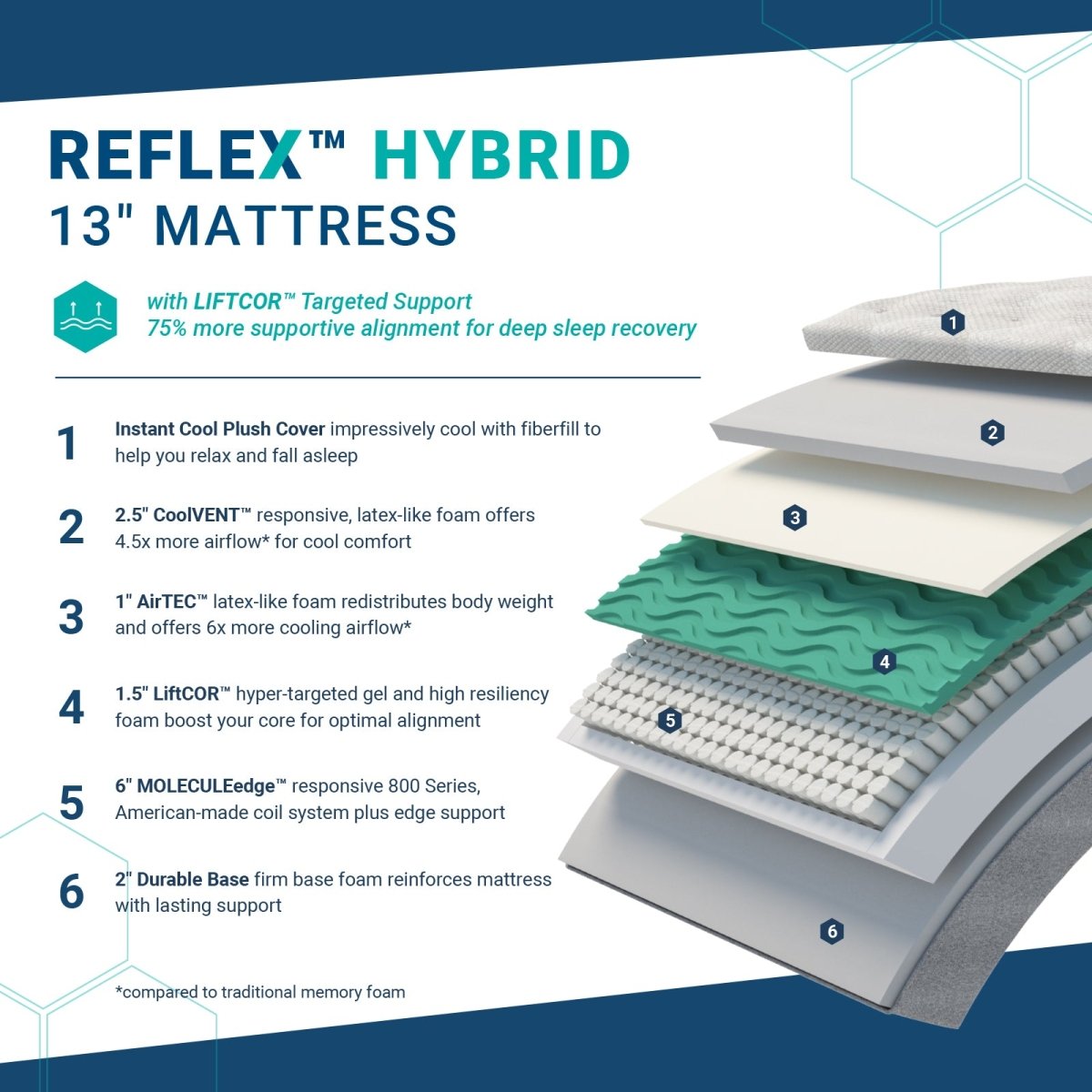
If a decade-old innerspring is the reason you're reading this, the practical next step is to compare how today's builds hold up. A NatureFlex hybrid built to resist comfort-layer sag behaves very differently than the worn coil unit you may be on now. Browse the collection to compare builds and find your match — and see our deeper look at latex and eco-friendly materials if longevity is a priority.

What are the signs it's time to replace your mattress?
Replace it when you see lasting body impressions or sagging, wake up sore, hear poking coils, notice odors or stains, or consistently sleep better away from home. These signals tell you the surface has stopped supporting and protecting you — which matters more than any birthday on the law tag.
Visible sagging, body impressions, or lumps
A dip that doesn't bounce back is the single most-cited replacement signal across sleep guidance.
"If you notice a lingering impression when you get off your mattress or if it visibly sags, it's probably time to replace it." — Naturepedic, 5 Signs It's Time to Replace Your Mattress
Some sinkage is normal over time — as Brooklyn Bedding notes, "all mattresses will show some signs of sinkage, since the foam in your bed as well as the springs will slowly lose their elasticity." The question is whether the surface still returns to flat or holds the shape of your body after you get up.
Waking up sore, stiff, or achy
New morning pain that fades as the day goes on often points to lost support.
"Morning aches and pains, stiffness, sore muscles, tingling or numbness in your extremities, and feeling groggy and fatigued despite a full night's sleep are all signs of a worn-out mattress." — Mattress Firm, How Often Should You Replace Your Mattress?
Noisy or poking coils
Squeaks, creaks, or springs you can feel through the surface mean the coil unit is fatiguing. Per WebMD, a failing foundation or coils that disrupt sleep can make a mattress unacceptable before it even hits its age threshold.
Worsening allergies, congestion, or stains
Older mattresses can accumulate dust mites and allergens, especially when sweat and staining build up over years. The U.S. Environmental Protection Agency and NIH/NIAID both publish guidance on reducing indoor dust-mite and allergen exposure through bedding hygiene and protective covers. To be clear, a mattress doesn't cause illness — but persistent congestion that eases when you sleep elsewhere, paired with old staining, is a reasonable hygiene-based reason to replace.
You sleep better away from home
If you consistently wake more rested in a hotel or guest bed, your own mattress may no longer be doing its job. Before you commit, it's worth knowing how to evaluate a replacement — our guide on how to test a mattress before buying walks through what to feel for.
Replace now or monitor a while longer? A simple decision framework
Replace now if your mattress sags, hurts your back, or smells; you can usually wait if it's still supportive, clean, and comfortable despite its age. This is the budget-aware reader's real question — and the answer depends on condition, not just the calendar.
Replace now if you see:
- A visible sag or body impression that doesn't recover after you get up
- A failing foundation or box spring, or coils you can feel or hear
- Recurring morning back, neck, or joint soreness that eases through the day
- Persistent odors or staining you can't clean out
Okay to monitor a while longer if:
- Wear is minor and cosmetic, and the surface still feels flat and supportive
- You wake up without new aches and sleep well most nights
- You've rotated it recently and it still recovers its shape
- It's protected, clean, and comfortable despite its age
Honest trade-off: a new mattress is not a guaranteed fix for back or joint pain. Discomfort can have many causes — posture, injury, or medical conditions — so if pain persists after a fresh, supportive bed, see a clinician. A mattress can support better sleep, but it isn't a medical treatment.
Once you've concluded your bed is genuinely done, the next decision is firmness and feel. Find your firmness in our quick quiz, which matches your sleep position and preferences to the right build. And because cost shouldn't be the barrier to better sleep, every order ships free, and you can ask about our financing options — 0% APR from $29/month — so the right mattress fits your budget, not just your back. Comparing curated builds in the buying-essentials guide is a smart parallel step.
How can you make your mattress last longer before replacing it?
Rotate it regularly, use a quality protector or encasement, and give it proper base support. These steps slow uneven wear and guard against the sweat, stains, and dust mites that shorten a mattress's usable life — though maintenance slows wear, it doesn't reset the clock.
- Rotate on a schedule. Purple suggests rotating about every 3 months, while GoodRx recommends roughly every 6 months — always per your manufacturer's instructions, since some modern beds shouldn't be flipped. Rotating evens out where your body presses night after night.
- Use a protector or encasement. A quality cover shields against spills, sweat, stains, and dust-mite buildup — the same allergen control the EPA recommends for bedding. A full-zip encasement that seals the mattress against sweat and allergens is the simplest way to protect your next bed from day one. A breathable DreamFit Comfort protector works well for everyday spills.
- Give it proper base support. A sagging or under-supported foundation transfers stress to the mattress and accelerates dipping. A sturdy platform, slatted frame, or compatible foundation keeps the surface flat and even.
Maintenance buys you time — sometimes a year or two of good sleep — but it can't restore a comfort layer that's already collapsed. When the surface no longer recovers, it's replacement time.
What should you do with your old mattress when you replace it?
You don't have to send it to a landfill. Through our mission-driven, buy-one-donate-one model, your purchase helps put a quality mattress in the hands of a local family in need — so replacing your bed becomes an act of community impact rather than waste.
That's the part of replacement that feels good instead of wasteful. For eco-conscious and value-aware sleepers alike, keeping a worn mattress out of the waste stream while supporting a neighbor turns a routine upgrade into something meaningful. It's the same sustainability thinking behind our eco-friendly mattress guide.
When you're ready for your next bed, you have two helpful paths. Huntsville-area readers can schedule a personalized in-store appointment for expert guidance and a chance to feel each build in person. Prefer to shop from home? Shop online — quality mattresses delivered with free shipping, and ask about our financing options from $29/month so the right mattress fits your budget. Not sure where to begin? Start with our curated collection of quality builds or the firmness quiz — and if you're also rethinking your bed size, our mattress size guide pairs perfectly with this one.
Frequently asked questions about replacing your mattress
How often should you replace your mattress?
About every 7 to 10 years for most mattresses, with some guidance recommending every 6 to 8 (Sleep Foundation, 2025). There's no fixed expiration date — replace sooner if the bed sags, leaves lasting impressions, or stops supporting you comfortably.
Do memory foam, hybrid, innerspring, and latex mattresses last the same amount of time?
No. Latex tends to last longest (up to 10–15 years), memory foam and hybrids around 7–10 years, and innerspring the shortest at roughly 5–8 years, per consumer guidance from Leesa and Purple. Material density and quality drive the differences.
Can I keep using my mattress if it only has a small sag or body impression?
Possibly, if the surface still recovers its shape and you wake without new aches. But a lasting impression that doesn't bounce back is a strong replacement signal — Naturepedic calls a lingering impression or visible sag a clear sign it's probably time to replace.
Do allergies, dust mites, or odors mean I need a new mattress?
They can, especially with older beds that show staining or buildup. The EPA and NIH/NIAID note that reducing dust-mite and allergen exposure improves indoor air quality. A protector helps, but persistent congestion plus heavy staining is a reasonable hygiene reason to replace.
Is it worth replacing a mattress if it still feels comfortable?
Not necessarily. If it's still supportive, clean, and pain-free, age alone isn't a reason to replace — ISPA (2023) found beds average 13.2 years and noted that age doesn't equal useful life. Let condition, not the calendar, decide.
How can I make my mattress last longer?
Rotate it every 3–6 months per the manufacturer's instructions, use a quality protector or encasement against sweat and dust mites, and give it firm, even base support. These steps slow uneven wear, though they can't restore a comfort layer that's already broken down.



Leave a comment
All comments are moderated before being published.
This site is protected by hCaptcha and the hCaptcha Privacy Policy and Terms of Service apply.