

You spent good money on a new bed, and now it feels firmer or just off compared to the showroom — and you're wondering if you chose wrong. You almost certainly didn't. Most people adjust to a new mattress in about 2 to 4 weeks, while the full break-in can run 30 to 90 nights as the materials condition and your body recalibrates. Here's the honest science behind both — and how to know when patience is the right call.
Key takeaways
- Most sleepers adjust in 2–4 weeks; the full break-in commonly runs 30–90 nights (industry consensus, not a single proven number).
- Two things happen at once: the materials condition to your heat and weight, and your body recalibrates to new support.
- Break-in varies by build — natural latex feels right in days, dense memory foam can take 30–60 days.
- Discomfort isn't always the mattress: room humidity (ideally 40–60%) and stress change how a bed feels.
- A 90–120 night trial is the industry-standard safety net, so being patient is low-risk.
How long does it take to get used to a new mattress?
The two processes overlap — materials conditioning and your body recalibrating — which is why a bed can feel noticeably better in week three than it did on night one.
Be clear-eyed about the numbers, though: high-quality peer-reviewed research does not establish a single universal "adjustment period." What the literature does show is that sleep and comfort outcomes can shift over a short window of repeated use. A 2015 study in Sleep Science by Ancuelle and colleagues followed 40 older adults with musculoskeletal pain across four weekly check-ins and found that sleep quality and pain scores improved after switching to a medium-firm adapted mattress (Ancuelle et al., 2015, Sleep Science, n=40). That supports a real adaptation window — but with a small sample, it's suggestive, not a stopwatch.
"Typically, within 2 to 4 weeks, the initial discomfort from adjusting will start to fade for many people, allowing them to fully enjoy the comfort and support provided by their new mattress." — Mattress World Northwest
Bottom line: treat the 30–90 night range as helpful industry guidance, not a medical fact. Your trial period exists precisely because adaptation is personal. If you want a head start on a confident choice, our step-by-step guide to buying a mattress online walks through matching a build to your body before it ever arrives.

Why does a new mattress feel so firm or different at first?
A new mattress feels different because your body is recalibrating to new support at the same time the materials are still conditioning to your shape and heat. Neither happens instantly, so the first nights are the least representative of how the bed will eventually feel.
Your body is recalibrating
Your nervous system spent years memorizing the exact dips and sag of your old bed. A new surface redistributes pressure differently, and your proprioception — your sense of body position — has to relearn what "supported" feels like. A 2019 biomechanical review in PeerJ by Claudon and colleagues explains that comfort depends on the interaction between a mattress's properties and the user's own body build and sleeping posture (Claudon et al., 2019, PeerJ). In other words, "right" isn't a fixed property of the mattress — it emerges from how your body meets it over repeated nights.
The materials are still conditioning
Foams and comfort layers soften as they absorb your body heat and weight night after night. Dense foam in particular needs consistent pressure to reach its intended feel, which is why a bed can feel stiff out of the box and noticeably more cradling weeks later. This is mechanical, not a defect — the material is doing exactly what it's designed to do.
Showroom feel vs home feel: which is better?
Display models feel softer because hundreds of shoppers have already broken them in. As John Ryan By Design puts it:
"Display mattresses have been softened by numerous customers, whilst your new mattress needs time to adjust to your specific body contours." — John Ryan By Design
If that "it felt softer in the store" gap is what's nagging you, that attribute — a comfort layer that conditions to your body rather than a thousand strangers' — is exactly what a fresh mattress is built to deliver. Not sure which firmness suits your body and sleep position in the first place? Learn how to test a mattress the right way, or find your firmness in our quick quiz so the bed you choose is a closer match from night one.
Could it be the room or stress instead of the mattress?
Yes — bedroom humidity outside the ideal 40–60% range, temperature, and everyday stress can all make a new mattress feel wrong when the bed itself is fine. This is the angle most retailers skip, and it's often the real culprit behind a "something's not right" feeling.
Room climate genuinely changes how foam behaves: it influences how readily the material releases absorbed moisture and how it responds to your weight. Swissflex points to a target bedroom humidity of 40% to 60% to limit mold and help a mattress release moisture (Swissflex, environmental guidance) — note this is manufacturer/environmental guidance rather than a clinical finding, but it's a sensible range worth keeping.
Your sleep physiology also shifts across nights, independent of any single surface. A 2023 multinight polysomnography study tracking sleep and autonomic measures found those readings changed from night to night with repeated exposure, and that some sleepers were more sensitive to mattress-related differences than others (Multinight polysomnography study, PubMed Central, 2023). Layer in stress — which raises tension and lowers perceived comfort — and you can see why night one is a terrible day to judge a new bed.
There's a well-documented link between sleep quality and emotional wellbeing, which cuts both ways: a stressful week can make a perfectly good mattress feel uncomfortable. Our piece on how quality sleep boosts emotional health covers that connection in more depth. Before blaming the bed, check the thermostat, the humidity, and your stress level for a week.

How long does each mattress type take to break in?
Natural latex often feels right in 2–14 days, hybrids in about 2–4 weeks, and dense memory foam can take 30–60 days to fully soften. These ranges are industry consensus from mattress makers — useful expectations, not peer-reviewed measurements.
| Mattress type | Typical material break-in | What to expect |
|---|---|---|
| Natural latex | 2–14 days | Resilient and responsive; minimal change — most of the "settling" is your body adapting, not the material. |
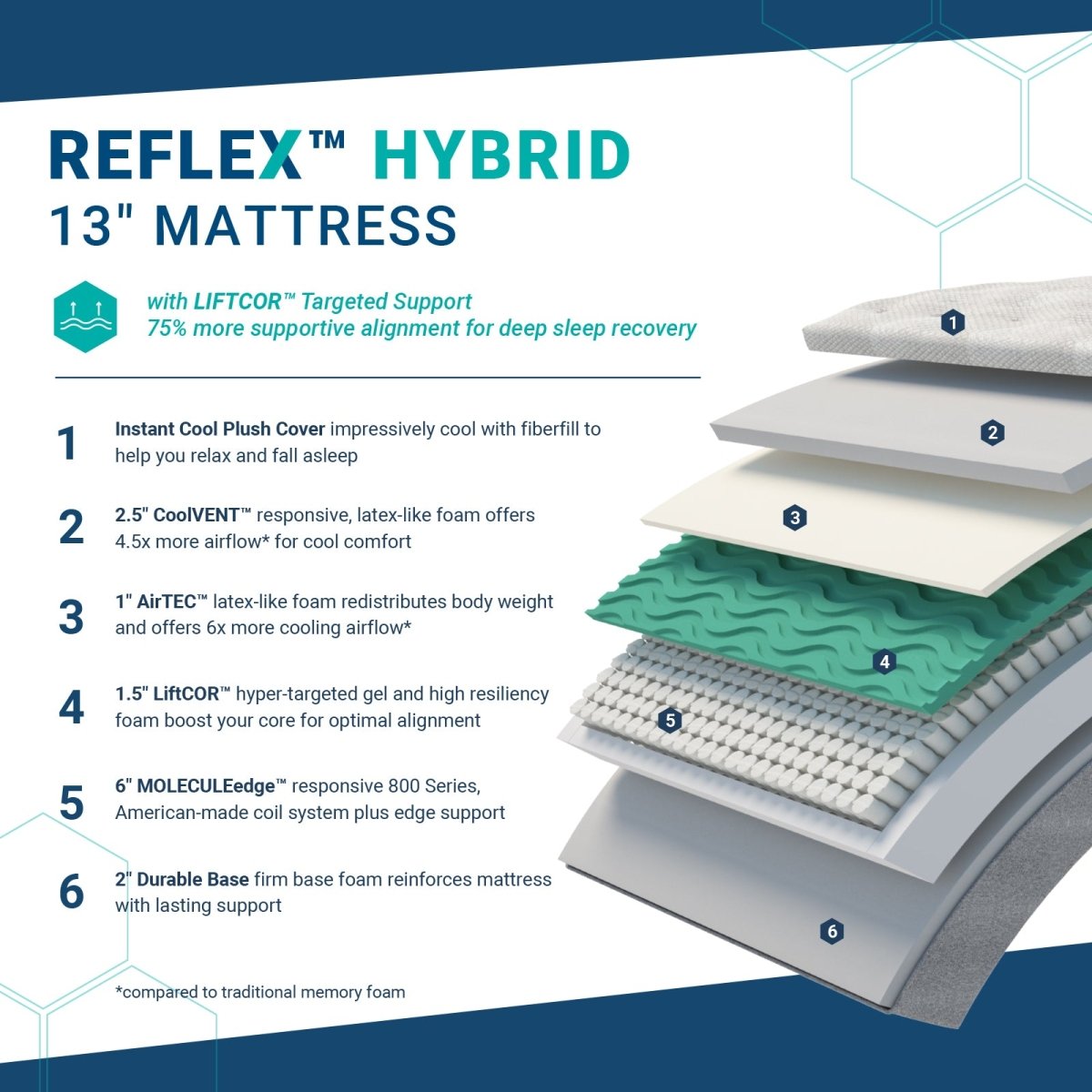
| Hybrid | ~2–4 weeks | Coils feel stable quickly; the foam comfort layer on top softens gradually for a few weeks. |
| Memory foam | 30–60 days | Dense foam needs consistent body heat and pressure to reach its intended cradle — the longest, most gradual break-in. |
| Innerspring | Shortest | Little material softening; comfort change is mostly your body adjusting to the support. |
Texas Mattress Makers frames the foam end of this range plainly: "breaking in a new mattress can take around 30-60 nights of you consistently sleeping on a mattress for it to adjust to your body, soften up, and give you the 'showroom' feel you experienced." The latex and innerspring numbers come from comparable retailer guidance (Slone Brothers, industry data) — treat them as expectations, not guarantees.
Want to compare how foam, hybrid, and latex actually break in and feel against each other? Browse our curated foam and hybrid builds to see how the layers differ — and lean on our expert guidance on matching a build to your sleep needs if you're unsure.
What does the research actually say about new mattresses and sleep quality?
Research strongly supports medium-firm mattresses for sleep quality and reduced back pain, and shows comfort can improve over a short window — but it does not pin down one universal adjustment timeline. Here's the honest evidence, including the parts that complicate the marketing story.
The strongest support for medium-firm comes from a 2021 systematic review of 39 controlled studies, which concluded that medium-firm mattresses are often associated with better sleep quality and less pain than very firm or very soft surfaces — while emphasizing the wide variation between studies (2021 systematic review, PubMed Central, 39 studies). A 2015 systematic review by Radwan and colleagues similarly associated medium-firm surfaces with improved sleep and reduced low-back pain (Radwan et al., 2015, Sleep Health). Notice the verb: associated with. This is the level the evidence supports — not a causal promise.
On the "things get better over time" front, a 2024 quasi-experimental study of a pressure-releasing medium-firm grid surface reported improvements in sleep quality, pain, mood, and daytime fatigue in adults with mild insomnia symptoms after switching surfaces (2024 grid-mattress intervention study, PubMed Central). Some older bedding evaluations have reported larger short-term gains in sleep quality and reduced back and shoulder discomfort after switching to a new surface, but those figures circulate without a primary paper that's easy to verify, so they're best treated as anecdotal rather than measured.
The candor competitors skip: a small 2024/2025 laboratory study of just 11 adults measuring muscle activity (EMG) across different mattress firmness levels found no statistically significant differences over time (Sensors, MDPI, 2025, n=11). Tiny sample, short window — but it's a fair reminder that "break-in time" has never been precisely measured in a lab.
So-what: the medium-firm sweet spot is well supported; the exact night-count is not. That's why getting the support right for your back matters far more than counting nights. This article is general sleep education, not medical advice — if you have persistent pain, check with a healthcare provider.
How can I speed up the mattress adjustment period?
Sleep on it every single night, spend extra relaxed time in bed, rotate it after 30 days, keep humidity at 40–60%, and give it the full trial window. Consistency does most of the work — there's no shortcut that replaces simply logging nights.
- Sleep on it nightly. Consistency is the single biggest factor — materials condition to your heat and weight only through repeated exposure, the same effect seen when sleep outcomes improved after switching surfaces in the 2024 intervention study. Avoid bouncing between the new bed and a couch or guest room.
- Add relaxed waking time. Reading or watching TV in bed for an hour in the evening adds conditioning hours without changing your sleep schedule.
- Rotate 180° after the first 30 days. This evens out break-in and helps prevent premature body impressions.
- Manage room temperature and humidity. Keep the bedroom near the 40–60% humidity range so foam conditions evenly and releases moisture properly.
- Pair it with a supportive base and bedding. A sagging foundation can sabotage an otherwise great mattress — a proper platform or adjustable base keeps the surface performing as designed.
- Give it the full trial. Resist judging in week one; let the materials and your body finish meeting in the middle.
This piece explains the why; for the deeper hands-on routine — unboxing, airing out, rotation schedules — pair it with our companion complete guide to testing and getting comfortable with a mattress. Bottom line: the fastest path is the boring one — sleep on it, every night, through the trial.
Green flags vs red flags: when to wait and when to act
Mild firmness that gradually eases is normal; sharp, persistent pain or no improvement after several weeks is your signal to use the trial period. Knowing the difference is what turns anxiety into patience.
Green flags — keep waiting (this is normal adjustment):
- The mattress feels slightly firmer than the showroom but is gradually softening week over week.
- Mild morning stiffness that eases as the day goes on and lessens over time.
- Better sleep on some nights than others — uneven progress is typical during adaptation.
- The bed feels more cradling at week three than it did on night one.
Red flags — take action (don't wait it out):
- Sharp, worsening, or radiating pain, or numbness and tingling.
- Zero improvement at all after 3–4 weeks of consistent nightly use.
- Visible sagging or a body impression that doesn't recover.
- The firmness feels wrong for your body type, not just unfamiliar.
Who medium-firm is NOT for: a strict, lightweight side sleeper may need something softer to relieve shoulder and hip pressure, while a heavier back or stomach sleeper may want firmer support to keep the spine aligned. "Medium-firm is optimal on average" doesn't mean it's optimal for everyone — your body type and sleep position decide. If the build is genuinely mismatched, no amount of break-in fixes it, and that's exactly what the trial protects against.
A sleep trial of 90 to 120 nights is the industry-standard comfort guarantee for evaluating a new mattress (Slone Brothers, industry standard), so patience generally costs you nothing — confirm your exact trial terms with our team. Reading your coverage carefully also helps; our guide to mattress warranties explains what sagging and support thresholds are typically covered.
Still adjusting? Here's your low-risk next step
If you're inside your trial window and still unsure, a personalized in-store appointment with a local sleep expert can confirm whether to wait or fine-tune your setup. Sometimes the fix is a different base, a firmness adjustment, or simply reassurance that you're right on schedule.
Want a second opinion from people who do this every day? Schedule a personalized in-store appointment with our local Huntsville sleep team — they'll talk through how your bed is breaking in and whether it's a match for your body. Prefer to keep comparing from home? Browse the collection to compare foam, hybrid, and latex builds and find your perfect match.
A few things that make settling in lower-risk: free shipping on every order, a sleep trial so you can give the bed a fair chance, and financing options (ask our team about 0% APR plans) so the right mattress fits your budget. And because we run a buy-one-donate-one model, your purchase also helps provide a quality bed to a local family in need — better sleep for you, and for your community.
Frequently asked questions about getting used to a new mattress
Why does my new mattress feel so firm at first?
Your bed feels firm initially because the foam and comfort layers haven't yet conditioned to your body heat and weight, and your body hasn't recalibrated to the new support. Showroom models feel softer because many shoppers already broke them in. The firmness typically eases over the first few weeks of nightly use.
How long does it take to get used to a new mattress?
Most people adjust in about 2 to 4 weeks, while the full break-in commonly runs 30 to 90 nights as materials condition and your body adapts. These ranges are industry consensus rather than a single proven figure — peer-reviewed research supports adaptation over a short window but doesn't establish one universal timeline.
Is it normal to feel pain or stiffness on a new mattress?
Mild stiffness that eases through the day and lessens week over week is normal as your body adapts to new pressure distribution. Sharp, persistent, or worsening pain, numbness, or pain that doesn't improve after several weeks is not typical — that's your signal to use your trial period. Persistent pain warrants a chat with a healthcare provider.
Can room humidity affect how my new mattress feels?
Yes. Bedroom humidity outside the commonly recommended 40–60% range can affect how foam releases moisture and responds to your weight, changing how the bed feels. Temperature and stress matter too — sometimes discomfort comes from the room or a hard week rather than the mattress itself, so check those before judging the bed.
What mattress type breaks in the fastest?
Natural latex typically feels right fastest — often within 2 to 14 days — because its resilient structure changes little, so most of the adjustment is your body adapting. Hybrids take roughly 2 to 4 weeks, while dense memory foam can take 30 to 60 days. These are industry estimates, not lab-measured guarantees.
Can I return my mattress if it still feels wrong after a few weeks?
A sleep trial — commonly 90 to 120 nights across the industry — exists so you can evaluate a mattress at home and act if it's genuinely not a match. Give it consistent nightly use first, then use the trial if red flags appear or it never improves. Confirm current trial terms with our team.





Leave a comment
All comments are moderated before being published.
This site is protected by hCaptcha and the hCaptcha Privacy Policy and Terms of Service apply.